Why Inclusion?
Is inclusion different from equality and equity?

To answer this question, I will ask you to look at the image below:
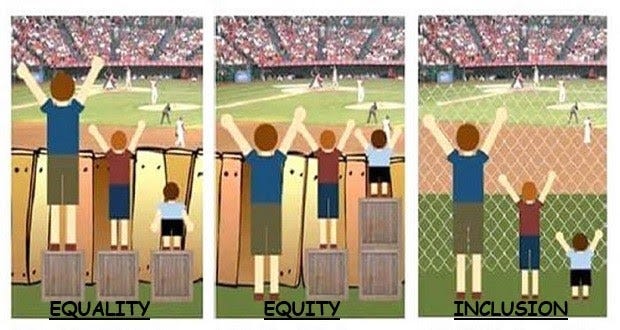
What you see in the picture are three humans with different needs and requirements. The fence represents the systemic barriers and the wooden boxes represent the support given to each.
Now let's delve deeper into each:
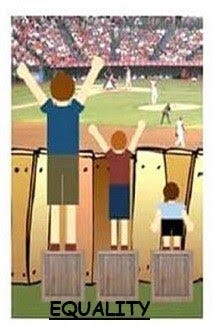
1. EQUALITY: This refers to treating everyone equally by providing them with the same support, assuming that everyone has the same needs.
In this picture, there are barriers before the humans. Each human is given one box each irrespective of their needs because everyone has to be treated equally. Also because it is assumed that everyone has the same needs.
Questions to ask:
Do all of them need the support?
Can all of them watch the game?
Is the support aligned to their need?
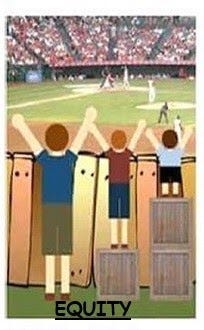
2. EQUITY: Different kinds of support provided to each, depending on their different needs.
In this picture, the barriers continue to exist. Each human is given need based support. The tallest human has been given no support while the taller
human is given one box for support and the short human is given two for support.
Yes equity is a better reality than equality but it is not without its loopholes.
Questions to ask:
Does equity help identify and address invisible needs?
Will equity manage to identify and address specific/special needs?
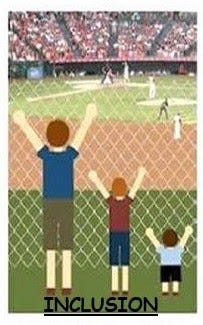
3. INCLUSION: Removes the barriers to accommodate all. No additional support is needed because the barriers causing inequity were removed for all.
In this picture the barriers are removed, as a result, all the three humans can see the match without the need for any kind of additional support.
These systemic barriers are a living reality and they are present in every strata of the society, namely caste, class, gender, color, education and so on.
If I were to look at education, systemic barriers come in the way of children with learning difficulties and learning disabilities or other kinds of neurodiversity and make them feel incompetent, unsuccessful, worthless and makes them quit easily.
In education the systemic barriers look like the following situations. We will also look at the situation from the perspective of neurodiverse children.
Situation 1: Teacher teaching and students listening:
What neurodiverse students experience: Now here the teacher keeps talking while the children are expected to either take notes or listen silently but a child with Attention Deficit Hyperactivity Disorder, where the predominant condition is inattention, will not be able to sustain their focus on the content for any longer than 5 minutes. Thereafter the child will get distracted or feel bored and hence start fidgeting or nudging a friend to talk or colouring with the pencil. The teacher calls out the child and reprimands the child which makes the child feel discouraged, angry and upset.
Situation 2: Dictations given for answers
What a neurodiverse child experiences: A child with Auditory processing disorder will find it difficult to process information heard because there is always a breakdown between information heard and processed. The child then loses focus and fails to follow what the teacher says. They also fail to distinguish between similar sounding words and end up making mistakes. The same reason makes them unpopular among friends, because they fail to understand what may be shared in a group. The child feels embarrassed upon being laughed at by peers or ridiculed by the teacher.
Situation 3: Content to be copied from the board
What a neurodiverse child experiences: A child with Visual processing disorder will find it immensely difficult to copy anything from the board. Visual processing disorder is a disorder in the brain and not the eye, owing to a disorientation between the eye and the brain leading to a breakdown in what is seen and what is interpreted. The child then either crams all words which then look illegible or reverse similar looking letters or entire words. The child looks into the copy of the friend and gets scolded for disturbing the friend.
Situation 4: Paper and pen assessments
What a neurodiverse child experiences: Children who are neurodiverse may not do well with paper and pen assessments because it requires reading and then processing that information to retrieve the correct answer and then writing it correctly on the paper. A child with Dyslexia or Visual Processing disorder will struggle with reading and therefore the other steps will not be reached at all. A child with dysgraphia will not be able to write an answer or one with dyscalculia will be unable to gauge the correct operation to apply and get all questions wrong. The child will end up doing poorly and be ridiculed by teachers, parents and peers alike. This will make the child isolate themselves from others, stop trying and finally quitting.
Situation 5: Teacher giving too many instructions at a stretch
What a neurodiverse child feels: “Open your science book to page 35 and look at the right page. Now look at the top left. Start reading from the second paragraph fourth line” - is an example of an instruction that is too long for children with learning disabilities/learning difficulties/ADHD to follow. By the time they manage to find their science book from their bag, the teacher has already reached the end of the instruction. Most peers have found the chapter, the page and the paragraph. The child feels anxious and struggles through pages to get to the right page and may nudge a friend to help. The teacher considers that as a disruption and shames the child before the class. The child feels embarrassed and loses motivation.
In the above mentioned situations, if looked at using the lenses of equality, equity or inclusion, we will observe the following::
Equality: Teachers follow a typical pattern of teaching because the system makes them do so. The teacher training courses such as B.ed may introduce the idea of teaching aids like anchor charts or kinesthetic learning methods but when it comes to administrative pressure from school authorities to complete certain portions within particular time periods, they find it difficult to make use of any aids and resort instead to methods that do not address the particular needs of children.
Equity: Some teachers or educational institutions may provide teachers with the knowledge and skills to use differentiation strategies, activities, anchor charts, hands on learning methods to help students learn and grow. In light of the above situations, teachers may be advised to:
use graphic organisers to help children take notes in them while the teacher speaks so the child with ADHD may not zone out or feel bored.
Teachers may use modified assessments and leverage the strength of children with learning disabilities to assess their mastery over a topic. Here some changes help address the needs of certain students who struggle with learning.
Inclusion: Inclusion will strive to create a classroom environment that is inclusive in all respects, starting with the seating arrangement, the classroom decor and the lessons taught and learnt. Looking at the situations again, inclusion will ensure every child in all the mentioned situations are able to grow and glow. Using strategies that are engaging, like:
flipped classrooms where kids already come prepared with theoretical knowledge and in class they work in groups to ideate and answer critical thinking questions or problem solving questions.
Creating stations and having children present learning to each other in turns.
Using simple techniques like putting up a picture of the topic to be taught and writing around it so all children can participate.
Use teamwork as a class culture and give role cards to each in a team, like a reader, a writer, an actor who will act out and so on, again so that no one feels left out.
While equality does not seem to serve any purpose, equity comes close but inclusion helps fight the systemic barriers the best and also enables one to gradually eliminate it from the picture altogether.
Let us all come together and make inclusion a reality so that systemic barriers can be broken and learning can be made possible to all kids.
Remember that all children deserve to be educated and not just a chosen few.
Remember that inclusion is for all and not just a selected few.
Remember that not all children can afford a special school.
We need more mainstream schools to embrace inclusive education and help embed inclusion in the educational system.